 Nic
Nic
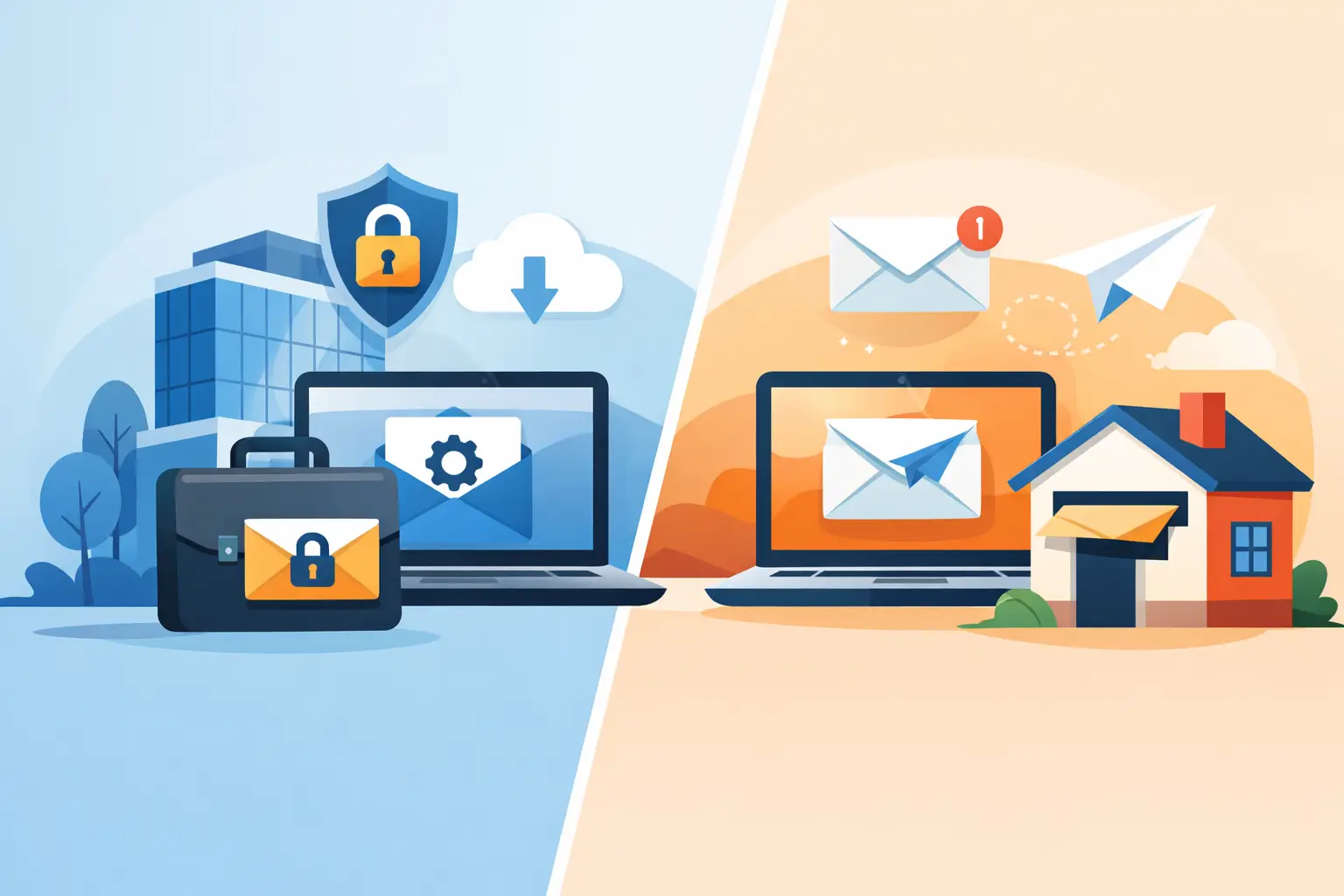
A customer is ready to ask for a quote. They see two contact options: hello@yourbusiness.co.uk or yourbusiness247@gmail.com. Both will deliver the message, but they do not send the same signal. That is the real issue in business email vs free email. It is not just about sending and receiving messages. It is about trust, control, security, and how seriously your business appears from the first contact.
For many UK small businesses, freelancers, charities and start-ups, free email is where everything begins. It is quick, familiar and costs nothing upfront. That makes it useful, especially when you are moving fast. But once you are trading publicly, speaking to clients, or managing a team, the limits start to show.
A free email account is tied to a public provider and uses that provider’s domain, such as Gmail or Outlook. A business email account uses your own domain, such as you@yourcompany.co.uk. On the surface, that may sound like a branding detail. In practice, it changes how your business is perceived and how your communication is managed.
With free email, you are using a tool designed for the general public. With business email, you are using an address tied directly to your company identity. That usually comes with more control over users, mailboxes, aliases, storage, security settings and account ownership.
For a sole trader who only needs a simple inbox, free email can be enough for a short period. For a business that wants to look established, protect its brand and keep communication organised, business email tends to be the better fit.
People make quick decisions. If your email address uses your business name and domain, it looks established and intentional. If it uses a free provider, some people will not mind, but others will wonder whether the business is new, informal, or not fully set up.
That matters more in some sectors than others. A local tradesperson may still win work with a free email address if they have strong reviews and answer quickly. A consultant, agency, solicitor, accountant or charity asking for donations will usually benefit far more from a professional address. The higher the trust requirement, the more your email address matters.
It also helps with consistency. When your website, domain and email all match, your brand feels joined up. That creates a smoother experience for customers and makes your business easier to remember.
There is a reason free email is popular. It is easy to set up, simple to use, and available on every device. For very early-stage projects, that is attractive. You can register an account in minutes and start sending messages straight away.
The trade-off is that convenience usually comes with less ownership. The email address is not really part of your business assets in the same way your domain is. If you change your trading name, launch a proper website, or bring in staff, the free account can start to feel like a temporary fix that stayed too long.
Free email can also become messy over time. One person handles enquiries. Then a partner needs access. Then invoices go somewhere else. Then a staff member leaves but still knows the login. What started as simple can turn into a patchwork of inboxes, forwards and shared passwords.
For many small organisations, security only becomes urgent after something goes wrong. A compromised inbox can expose customer details, password resets, invoices, conversations and internal decisions. Email is often the front door to everything else.
Business email generally gives you more control over that risk. You can create separate mailboxes for different people, remove access when someone leaves, set stronger policies, and manage accounts centrally. You are less reliant on one person’s personal login habits.
There is also the issue of ownership. If a member of staff uses a personal free email account for business and later leaves, who owns that correspondence? Who keeps the client history? Who can access old messages? With a domain-based business mailbox, the answer is far clearer. The business owns the account.
That clarity matters for freelancers growing into agencies, charities with volunteer turnover, and small firms with shared admin responsibilities. A proper setup prevents avoidable headaches later.
Most people think email problems mean messages bouncing. More often, the problem is quieter than that. Your email lands in spam, gets filtered, or is treated with more suspicion because the sender does not fully match the business they claim to represent.
Using business email on your own domain can improve trust signals when it is configured properly. That does not guarantee every message reaches the inbox, because deliverability depends on several factors, but it does give you a more professional sending identity.
This is especially useful when sending quotes, invoices, booking confirmations or enquiry replies. If customers are waiting for something important, you want every advantage in getting your message seen.
A lot of owners assume business email is only for larger companies. In reality, it starts being useful as soon as more than one person touches communication. Even a two-person business can benefit.
Separate addresses such as sales@, accounts@ or support@ make your business easier to deal with. They also protect continuity. If one person is off sick, on holiday or leaves the business, the address still exists and the customer contact point stays the same.
That continuity is hard to recreate with free personal inboxes. Customers end up chasing individuals instead of your business. Over time, that can make service feel less reliable than it actually is.
Free email wins on upfront price. There is no point pretending otherwise. If your only question is what costs less this month, free email will be the answer.
But most businesses should ask a better question: what is the cost of using the cheaper option for too long? If a professional email address helps you appear more credible, stay organised and reduce admin friction, the value is not limited to the monthly fee.
For many small businesses, business email is one of the lower-cost parts of their online setup. Compared with the cost of losing a lead, missing an invoice thread, or looking less established than a competitor, it is usually a sensible spend.
That is even more true when email is bundled with hosting and domain management in one place. A simpler setup reduces the chance of forgotten renewals, awkward handovers and multiple support contacts. For businesses that want less fragmentation, that convenience is worth a lot.
There are cases where free email remains practical. If you are testing a side project, running a short-term community initiative, or not yet ready to buy a domain, there is nothing wrong with starting there. Speed and low cost do matter.
It can also be fine for personal use that touches light business activity, such as early networking or initial supplier research. Not every situation needs a polished branded mailbox from day one.
The key is to recognise it as a starting point, not always a long-term solution. Once your business has a website, takes enquiries, sends invoices or wants to build trust at first glance, a business email address usually makes more sense.
If your email is customer-facing, linked to payments, shared across staff, or central to your reputation, choose business email. If it is temporary, experimental or not yet public, free email may be enough for now.
Think less about features and more about what your inbox represents. Is it just a place where messages arrive, or is it part of how customers judge your business? For most established organisations, the answer is obvious once the question is framed that way.
A professional email address will not fix poor service or win every sale on its own. But it does support the basics that matter: trust, clarity, ownership and continuity. That is why so many businesses move away from free accounts once they want a setup that feels stable and ready to grow.
If you are already paying for a domain and website, matching your email to your brand is often the next sensible step. It is a small change on paper, but it can make your business look more settled, more credible and easier to deal with from the very first message.
You must be logged in to post a comment.