
 Nic
Nic
Choosing a web hosting plan based on price alone is one of the most common mistakes small business owners make. The appeal is obvious: a £1.99 per month plan looks like a smart way to keep overheads low, especially when you are just starting out. But understanding why cheap hosting is risky goes beyond the obvious complaints about slow speeds. The real costs are hidden in security vulnerabilities, lost customers, wasted time, and pricing traps that only reveal themselves months after you have signed up. This article breaks down exactly what you are taking on when you opt for the cheapest option available.
| Point | Details |
|---|---|
| Performance affects revenue | Slow load times and frequent downtime directly reduce customer retention and sales conversions. |
| Security risks are elevated | Shared servers with poor isolation increase the chance of malware spreading to your site. |
| Hidden costs add up fast | Renewal price hikes, paid add-ons, and time spent on maintenance often exceed the initial savings. |
| Support quality matters | Slow, generic support responses can leave your site broken for hours during critical trading periods. |
| Evaluate before you commit | Check uptime guarantees, included security features, and renewal pricing before choosing any host. |
The most visible problem with budget hosting is what happens to your website’s speed and reliability. Most cheap providers use a model called overselling, where 1,000 to 3,000 websites share a single server. The logic is that not everyone will have a traffic spike at the same time. When they do, though, your site slows to a crawl, and there is nothing you can do about it.

Uptime figures are another area where the reality rarely matches the marketing. Many budget providers advertise 99.9% uptime, which sounds reassuring. In practice, real uptime on cheap plans is often closer to 99.5%, which translates to more than 43 hours offline per year. For a business that relies on its website to generate enquiries or sales, that is a significant amount of lost opportunity. You can read more about why uptime matters for businesses of all sizes.
Speed problems do not just frustrate visitors. They cost you money in measurable ways.
Pro Tip: Use a free tool like Google PageSpeed Insights to test your current site speed. If your score is below 70 on mobile, your hosting environment may be a contributing factor.
Security is where the risks of cheap hosting become genuinely serious. Most budget providers place hundreds of websites on a shared server without strong account isolation. This means that if one site on the server is compromised, malware can spread to neighbouring accounts. Your site could be infected through no fault of your own.
The financial consequences are not trivial. A single malware infection on a poorly secured shared server costs between $200 and $500 to clean up, and that figure excludes revenue losses. If Google flags your site as unsafe, your organic traffic can drop by up to 95% almost overnight. Recovering that ranking takes weeks or months of effort.
A site flagged as unsafe by Google does not just lose traffic. It loses the trust of every visitor who sees that warning, and trust is far harder to rebuild than rankings.
Beyond malware, cheap hosting security issues often include outdated software. Budget hosts frequently run outdated PHP versions with low memory limits, leaving known vulnerabilities unpatched for extended periods. Managed hosting providers, by contrast, handle these updates proactively. If you handle any customer data, payment information, or personal details, this gap in security practice creates real compliance exposure under UK GDPR.
Pro Tip: Check whether your current host includes a Web Application Firewall (WAF) and automated malware scanning as standard. If these are listed as paid add-ons, that is a warning sign. Hexhosting’s guide to malware protected hosting explains what these protections actually do.
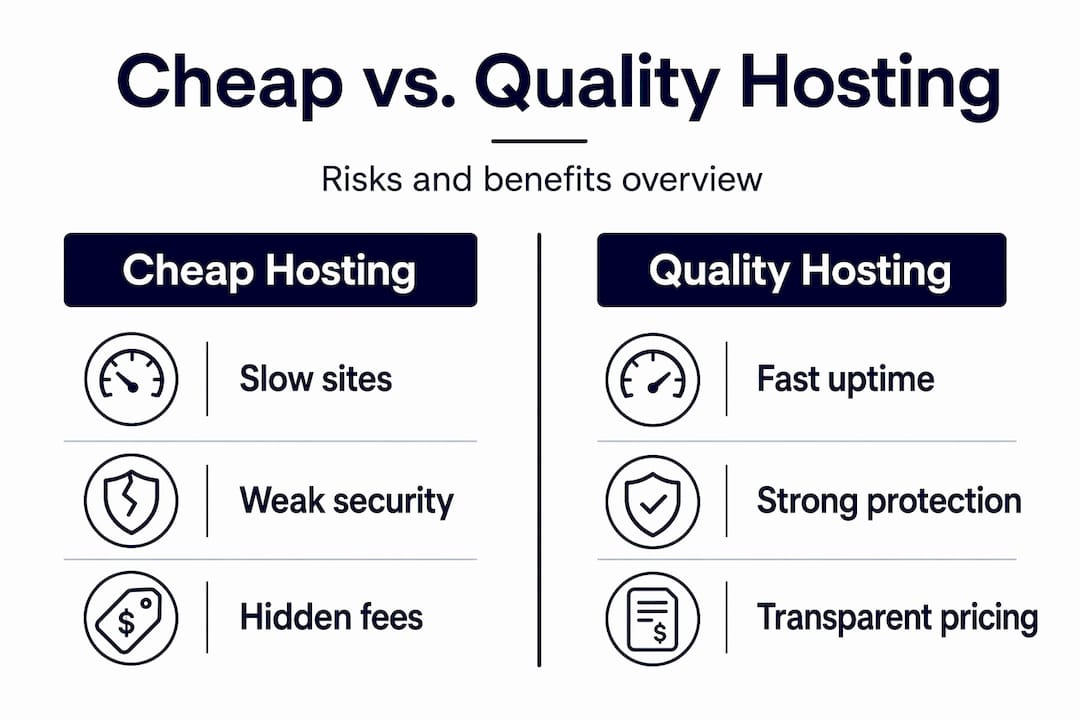
The sticker price of cheap hosting is almost never the real price. This is one of the most important drawbacks of budget hosting to understand before you commit. The promotional rate you see advertised is typically a short-term introductory offer. When your contract renews, the price often doubles or triples without any warning.
Here is how the hidden costs typically accumulate:
| Cost type | Cheap hosting | Quality hosting |
|---|---|---|
| Monthly base price | £1.99 (introductory) | £8 to £15 (transparent) |
| SSL certificate | Often extra | Usually included |
| Backups | Often extra | Usually included |
| Founder time per month | 9 to 12 hours | 1 to 2 hours |
| Renewal price increase | Common, often 2x to 3x | Stable or clearly stated |
Pro Tip: Before signing up with any host, search for their renewal pricing specifically. It is rarely on the homepage. Hexhosting’s guide to hosting renewal traps shows exactly what to look for.
When something goes wrong with your website, the quality of your hosting provider’s support team becomes the most important thing in the world. This is one area where the disadvantages of low-cost hosting are felt most acutely by small business owners.
Budget hosting support typically looks like this:
Compare that to quality hosting providers, where response times are often under five minutes and support agents can diagnose and resolve server-level issues directly. If your site goes down on a Monday morning during a product launch or a busy trading period, a six-hour wait for a generic reply is not just frustrating. It is a direct financial loss. Rapid technical assistance is not a luxury for a small business. It is part of what keeps the operation running.
Knowing why cheap hosting is risky is only useful if it helps you make a better decision. Here is a practical framework for assessing any hosting provider before you commit.
Check the uptime guarantee and how it is enforced. A genuine 99.9% uptime guarantee should come with a service level agreement and compensation terms. If the provider cannot clearly explain what happens when they miss their target, the guarantee is largely meaningless.
Understand what is included as standard. Ask specifically about SSL certificates, daily backups, malware scanning, and a firewall. If any of these are listed as paid add-ons, factor that into your total cost calculation. A plan that appears cheap can quickly become expensive once you add the features your site actually needs.
Read the renewal pricing before you sign up. This one step alone will save you a significant amount of money and frustration. Look for the post-introductory price in the terms and conditions, not just the headline rate on the homepage.
Assess the support offering. Does the provider offer live chat or phone support? Are their support hours aligned with UK business hours? Can they demonstrate expertise with the platform you use? These questions reveal a great deal about what your experience will be when something goes wrong.
Consider managed hosting for peace of mind. For most small business owners, managed hosting is worth the modest additional cost. The provider handles updates, security patches, and performance monitoring. You focus on running your business. Hexhosting’s guide to choosing the right hosting walks through these considerations in more detail.
Pro Tip: Ask any prospective host for their average support response time in writing. If they cannot provide a figure or it is vague, that tells you everything you need to know about how they will treat you when you have a problem.
I have seen the same pattern repeat itself more times than I can count. A business owner picks the cheapest hosting plan available, spends the first few months thinking they have made a smart decision, and then hits a wall. Maybe it is a security incident, a site that starts ranking poorly, or a renewal invoice that is three times what they expected. The savings evaporate, and the disruption costs far more than a better plan ever would have.
What I have come to believe is that hosting is infrastructure, not a monthly expense to minimise. You would not choose the cheapest possible commercial premises for your shop if it meant the roof leaked and the locks were unreliable. Your website deserves the same logic. The operational drag on founders who manage cheap hosting themselves is real, and it compounds over time. Every hour spent troubleshooting a server error is an hour not spent on your customers, your product, or your growth.
The good news is that reliable, secure hosting does not have to be expensive. It just has to be honest about what it includes. That distinction matters enormously.
— Nic
If the risks outlined above sound familiar, or if you want to avoid them entirely, Hexhosting offers UK-based web hosting designed specifically for small businesses and individuals who need reliability without complexity.
Every Hexhosting plan includes SSL certificates, daily backups, malware protection, and transparent renewal pricing as standard. There are no surprise add-ons and no introductory rate that doubles after three months. Support is handled by people who understand the platforms small businesses actually use. Whether you are launching your first site or migrating away from a host that has let you down, Hexhosting’s affordable UK web hosting packages are built to give you confidence in your online presence. You can also explore cheap hosting done right to see how cost-effective and reliable can genuinely coexist.
Cheap hosting typically involves oversold servers, weak security, slow support, and hidden costs at renewal. These factors combine to create performance problems, security vulnerabilities, and total costs that often exceed what a quality plan would have charged.
Affordable hosting can be safe if it includes SSL, backups, malware scanning, and clear pricing as standard. The risk comes when low price is achieved by removing these protections or packing too many sites onto a single server.
Many budget providers deliver real uptime of around 99.5%, which equates to over 43 hours of downtime per year. A genuine 99.9% uptime guarantee reduces that figure to under 9 hours annually.
Beyond the introductory price, cheap hosting often charges extra for SSL, backups, and security tools. Renewal rates frequently double or triple, and founders typically spend 9 to 12 hours monthly on maintenance that quality hosting would handle automatically.
Look for a provider that publishes its renewal pricing clearly, includes security features as standard, offers responsive UK-based support, and has verifiable uptime records. Independent reviews and a transparent pricing structure are the most reliable indicators of a trustworthy host.
Article generated by BabyLoveGrowth
You must be logged in to post a comment.